
Running an Enterprise Global Link Campaign: A Practical Framework
Enterprise global link campaigns need market prioritization, cross-functional governance, and locale-specific execution across SEO, PR, and regional teams.
By Multilingual Link Building Agency
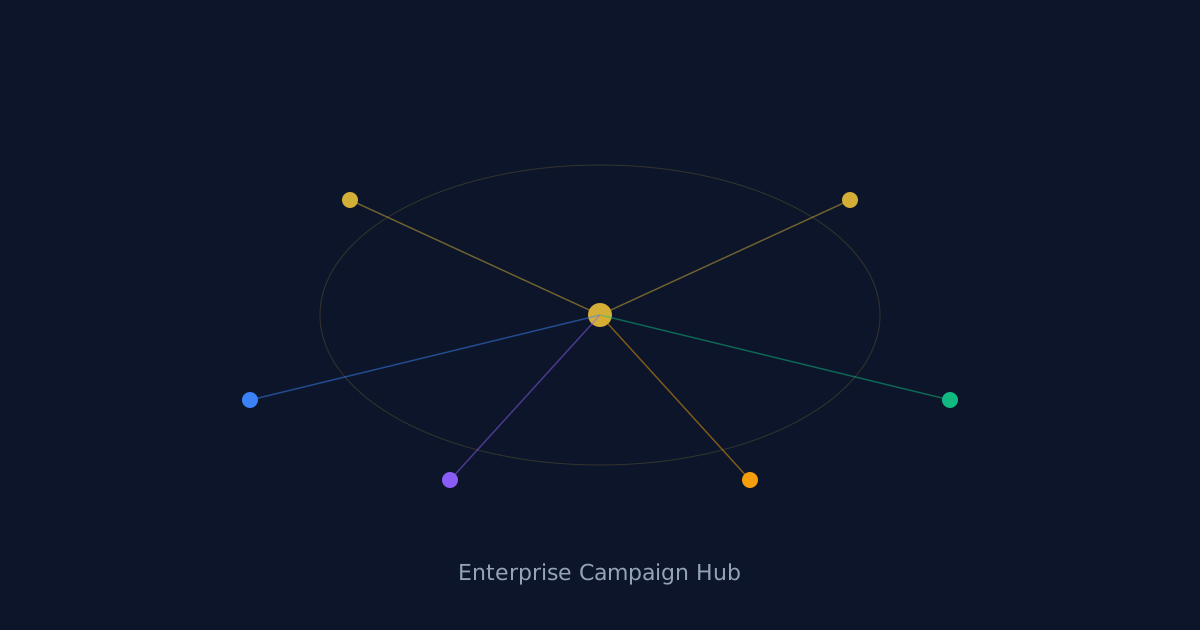
Enterprise global link campaigns differ from boutique agency engagements in scale, stakeholder complexity, and consequence. A misplaced outreach email does not merely waste a prospect—it can trigger legal review, regional PR escalation, or brand guidelines violations across dozens of markets. Success requires structure: clear governance, phased market rollout, integrated measurement, and executive sponsorship that treats link acquisition as market access—not a tactical SEO experiment.
This framework reflects patterns from multinational B2B, SaaS, and consumer brands running coordinated multilingual link building across three to thirty markets simultaneously.
Phase Zero: Strategic Alignment
Before prospecting a single domain, secure alignment on objectives, markets, and boundaries. Objectives should tie to business outcomes: organic pipeline in DACH, brand authority in APAC, competitive displacement in LatAm—not vanity metrics alone. Market prioritization uses a matrix of revenue potential, competitive backlink gap, and operational readiness (localized site quality, sales coverage, legal clearance for claims).
Define non-negotiables: prohibited tactics, disclosure requirements, approved messaging pillars, and escalation paths for sensitive placements. Document which markets launch in wave one versus later phases. Enterprise campaigns fail when every region demands simultaneous priority without capacity to match.
Stakeholder Map
Identify owners across SEO, regional marketing, PR/comms, legal, product marketing, and local sales. SEO typically leads strategy and measurement; regional marketing validates cultural fit; PR coordinates news-driven opportunities; legal reviews regulated claims; product marketing supplies link-worthy assets. Monthly steering committees prevent siloed outreach that contradicts concurrent brand campaigns.
Phase One: Infrastructure and Playbooks
Build shared infrastructure before scaling outreach:
- CRM or outreach platform with locale tagging and permission controls
- Prospect qualification rubrics adapted per region
- Localized template libraries with version control
- Asset repository linking to live localized URLs
- Reporting dashboards segmented by market and campaign
Develop playbooks documenting prospecting sources, outreach tone, follow-up rules, and placement QA for each wave-one market. Playbooks reduce dependency on individual practitioners and accelerate onboarding when teams expand.
Vendor and Internal Capacity Model
Enterprises choose among internal multilingual teams, regional agencies, and centralized specialized partners—or hybrids. Internal teams offer brand control; regional agencies offer relationships; centralized partners offer consistency and cross-market learning. Clarify RACI: who prospects, who approves pitches, who negotiates placements, who verifies live links.
Phase Two: Campaign Architecture
Structure campaigns around themes with multilingual legs—not isolated regional efforts. A global research report release should include:
- English digital PR push
- Localized press materials and data cuts per priority market
- Outreach to regional journalists and analysts
- Resource page and blogger outreach supporting long-tail links
- Internal linking from corporate blog to localized landing pages
Each leg shares timeline and messaging but executes with locale-specific targets and copy. Campaign briefs specify link targets (URLs per market), anchor guidance (brand and topical, not over-optimized), and success criteria beyond link count—referring domain quality, topical relevance, sentiment.
Quality Gates
Enterprise campaigns need placement review before celebration. Verify indexation, correct URL targets, rel attributes, surrounding editorial context, and disclosure compliance. Archive screenshots and live URLs for audit trails. Reject placements that violate playbook even if metrics look attractive—one toxic link in a regulated industry creates disproportionate risk.
Phase Three: Execution at Scale
Batch execution by market capacity, not arbitrary calendar symmetry. Wave-one markets receive full prospecting and outreach cycles; wave-two markets prepare assets and train teams while wave one generates learnings.
Maintain weekly operational rhythms: pipeline reviews, blocker escalation, response handling SLAs. Slow response to interested editors damages enterprise credibility more than boutique shops—regional publishers remember which brands waste their time.
Cross-market learning sessions share what worked: subject lines in France, data angles in Brazil, format preferences in Japan. Avoid copying tactics wholesale; extract principles adaptable locally.
Phase Four: Measurement and Optimization
Enterprise reporting serves multiple audiences. Executives need market-level progress against objectives: referring domain growth in priority countries, ranking movement on agreed keyword sets, organic contribution to pipeline. Practitioners need operational metrics: outreach volume, reply rates, placement rates, time-to-live-link.
Compare cost efficiency across markets cautiously—maturity, competition, and brand awareness differ. A low placement rate in a new market may reflect awareness gaps addressable through PR, not outreach failure alone.
Quarterly Strategic Reviews
Every quarter, reassess market prioritization. Shift resources toward markets showing traction or strategic urgency. Pause markets where localized sites remain substandard—links to thin pages underperform and waste editorial goodwill.
Common Enterprise Failure Modes
Centralized control without local input produces culturally flat outreach. Decentralized chaos without standards produces inconsistent quality and compliance gaps. Treating link building as SEO-only excludes PR-driven placements that anchor enterprise campaigns. Over-indexing on DR aggregates obscures missing coverage in critical regional publications.
Another failure: campaign sprints without sustainment. Global link campaigns need always-on prospecting between major launches to maintain velocity.
Closing the Loop With Leadership
Present enterprise global link campaigns as multi-year market infrastructure investments. Show cumulative referring domain curves by region, competitive gap closure, and correlation with organic revenue—not single campaign spikes. When leadership sees multilingual link building as essential to international growth—not a line item beneath translation—the enterprise framework delivers durable cross-border backlinks and search authority aligned with global ambition.
Post-Campaign Sustainment
Major launches end; link velocity should not. Transition campaign teams into sustainment mode with reduced but consistent prospecting quotas, evergreen asset refresh cycles, and standing relationships with tier-one editors in each market. Document lessons learned within two weeks of campaign close—what assets earned links, which markets over- or under-performed, which approvals slowed execution. Enterprise programs compound when institutional memory survives personnel changes and vendor rotations.
Ready to apply these strategies to your global campaigns?
Speak to Our Strategists