
Multilingual Link Building vs Standard SEO: What Global Teams Need to Know
Standard SEO and multilingual link building differ in scope and intent—global teams need both, but conflating them undermines international search performance.
By Multilingual Link Building Agency
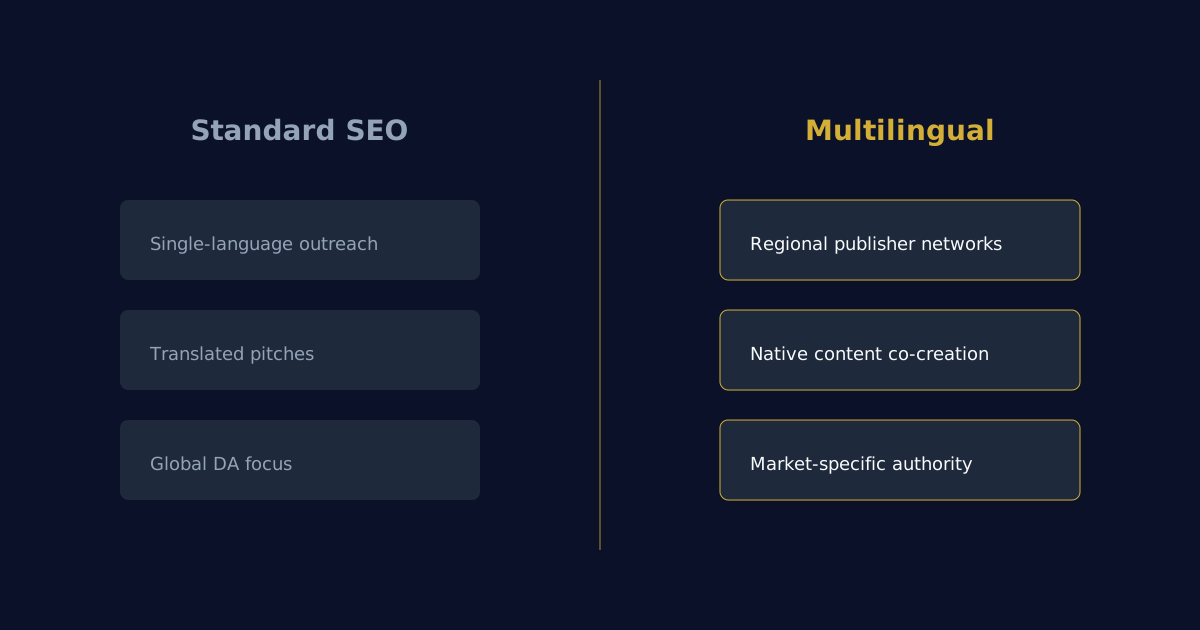
Standard SEO has a recognizable playbook: keyword research, on-page optimization, technical audits, content production, and link acquisition—usually in one primary language and market. Multilingual link building operates inside international SEO but follows different constraints, success metrics, and resource models. Conflating the two leads to underfunded global programs, misaligned KPIs, and the recurring executive question: “We rank well in English—why not everywhere else?”
The answer is rarely technical failure alone. It is strategic category error—applying monolingual SEO assumptions to multilingual realities.
Scope and Complexity
Standard SEO optimizes a unified site or a dominant language property. Multilingual link building optimizes multiple parallel entities connected by hreflang, brand, and product—not by shared link profiles. Each target market introduces distinct publisher landscapes, outreach languages, compliance considerations, and competitive sets.
Complexity scales non-linearly. Adding Germany, France, and Japan is not three times English effort. It is three ecosystems requiring native expertise, separate prospect databases, localized assets, and reporting segmented by locale. Standard SEO teams stretched across languages without dedicated capacity produce thin outreach and generic translated content—outcomes that look like activity without moving regional rankings.
Where Standard SEO Stops Short
Technical international SEO—hreflang, geotargeting, locale URL structures—is necessary but insufficient. Standard SEO content strategies often centralize topic selection at headquarters. Multilingual link building requires topics and hooks that earn attention locally. A keyword cluster winning in English may have lower volume or different intent in Korean; pursuing it with translated posts misses opportunities visible only to native researchers.
Link acquisition in standard SEO frequently leverages existing English-language relationships: PR coverage, guest posts on familiar industry sites, digital PR in Anglo media. Multilingual link building must cultivate relationships where they do not exist—regional trade journals, local influencers, language-specific resource pages invisible to English-only prospecting tools.
Metrics That Diverge
Standard SEO dashboards emphasize global organic traffic, head-term rankings on primary domains, and aggregate Domain Rating. Multilingual programs need locale-segmented KPIs:
- Referring domains by country and language of referring page
- Rankings on localized keyword sets per market
- Share of voice vs in-market competitors, not vs global rivals
- Organic conversions attributed to non-primary language URLs
- Outreach performance metrics by language team
Reporting aggregate gains while individual markets stagnate hides failure until revenue targets slip. Global teams need both views: portfolio performance and market-level accountability.
Risk Profiles Differ
Standard SEO link building risks—penalties from manipulative tactics, reputation damage from low-quality placements—apply globally. Multilingual contexts add layers: cultural missteps in outreach, non-compliant sponsored content in regulated markets, and language errors that become public screenshots on social media.
Standard SEO may tolerate higher automation in prospecting and outreach. Multilingual link building demands human review at language boundaries. The cost of error scales with visibility in markets where brand awareness is still forming.
Resource and Organizational Models
Standard SEO often lives in a centralized team serving one primary site. Multilingual link building succeeds with hybrid models: central strategy and quality standards, regional execution by native speakers or trusted partners, shared CRM and reporting infrastructure.
Attempting multilingual link building as a side project within a standard SEO team produces predictable bottlenecks. Outreach queues in languages no one on staff speaks. Translated templates go out without review. Prospects sit idle while English campaigns consume bandwidth. Dedicated capacity—internal or agency—signals organizational commitment markets interpret through sustained outreach quality.
Complementary, Not Competing
The comparison is not either/or. Standard SEO establishes foundation: crawlability, site speed, core content architecture, primary-market authority that funds global expansion. Multilingual link building extends authority into markets where growth strategy demands local visibility.
Sequence matters. Launching ten localized sites simultaneously without link building capacity spreads resources too thin. Prioritize markets by revenue potential and competitive gap, build playbooks in pilot locales, then replicate with documented processes.
Integration Points
Align both disciplines through shared calendars: product launches, research releases, and PR moments should trigger multilingual outreach, not only English digital PR. Unified keyword research feeds content and link targets—with locale-specific branches. Technical SEO ensures localized pages are indexable and correctly annotated before outreach drives traffic to them.
Decision Framework for Leadership
When evaluating program structure, ask:
- Do we measure success per language version or only in aggregate?
- Is outreach executed by people who can correspond credibly in target languages?
- Are link-worthy assets created for local audiences or imported via translation?
- Do competitive analyses include in-market backlink profiles?
- Is budget allocated proportionally to international revenue ambitions?
Affirmative answers indicate multilingual link building is resourced as distinct from standard SEO. Negative answers explain ranking gaps despite strong primary-market performance.
The Strategic Bottom Line
Standard SEO wins the home market battle. Multilingual link building wins access to markets where home-market authority does not travel. Global teams need both disciplines clearly defined, separately resourced, and jointly aligned to business priorities. Treating multilingual link building as “SEO but translated” guarantees underperformance; treating it as international market infrastructure delivers cross-border backlinks and search visibility that match global intent.
Red Flags That Signal Conflation
Watch for these organizational symptoms: a single “international SEO” owner responsible for ten languages without headcount support; outreach templates translated overnight before a product launch; reporting that shows only global organic traffic; competitive analyses comparing your .com to local .de competitors without separate backlink views. Each indicates standard SEO processes stretched beyond their design. Correcting course means naming multilingual link building explicitly in org charts, budgets, and quarterly reviews—not as an appendix to the English SEO roadmap.
Ready to apply these strategies to your global campaigns?
Speak to Our Strategists